/P0
91 / 154Intent fidelity
Owner requirements the compiler satisfies, on the production fast tier. The remainder are declared unsupported rather than guessed — this is our weakest link, and it is the number we improve.
Describe the business you want to run. WholeStack turns it into working software, verifies it, and takes it live.
Proof
Code that exists is not the same as code you can trust. Before anything goes live, WholeStack checks it against what your business asked for, tries to break it, and runs it for real.
/P0
91 / 154Owner requirements the compiler satisfies, on the production fast tier. The remainder are declared unsupported rather than guessed — this is our weakest link, and it is the number we improve.
/P1
28The release authority is a catalog you can read, not a claim you take on faith.
/P2
0ShipGate sits outside the generation loop, so no build approves its own work.
/P3
15The customer journey is executed against the live app before a verdict is issued.
One unbroken chain
What we build
Tell us how your business works: what you keep track of, who does what, and what must never go wrong. We build it, check it before it goes live, and can host it for you. You own it.
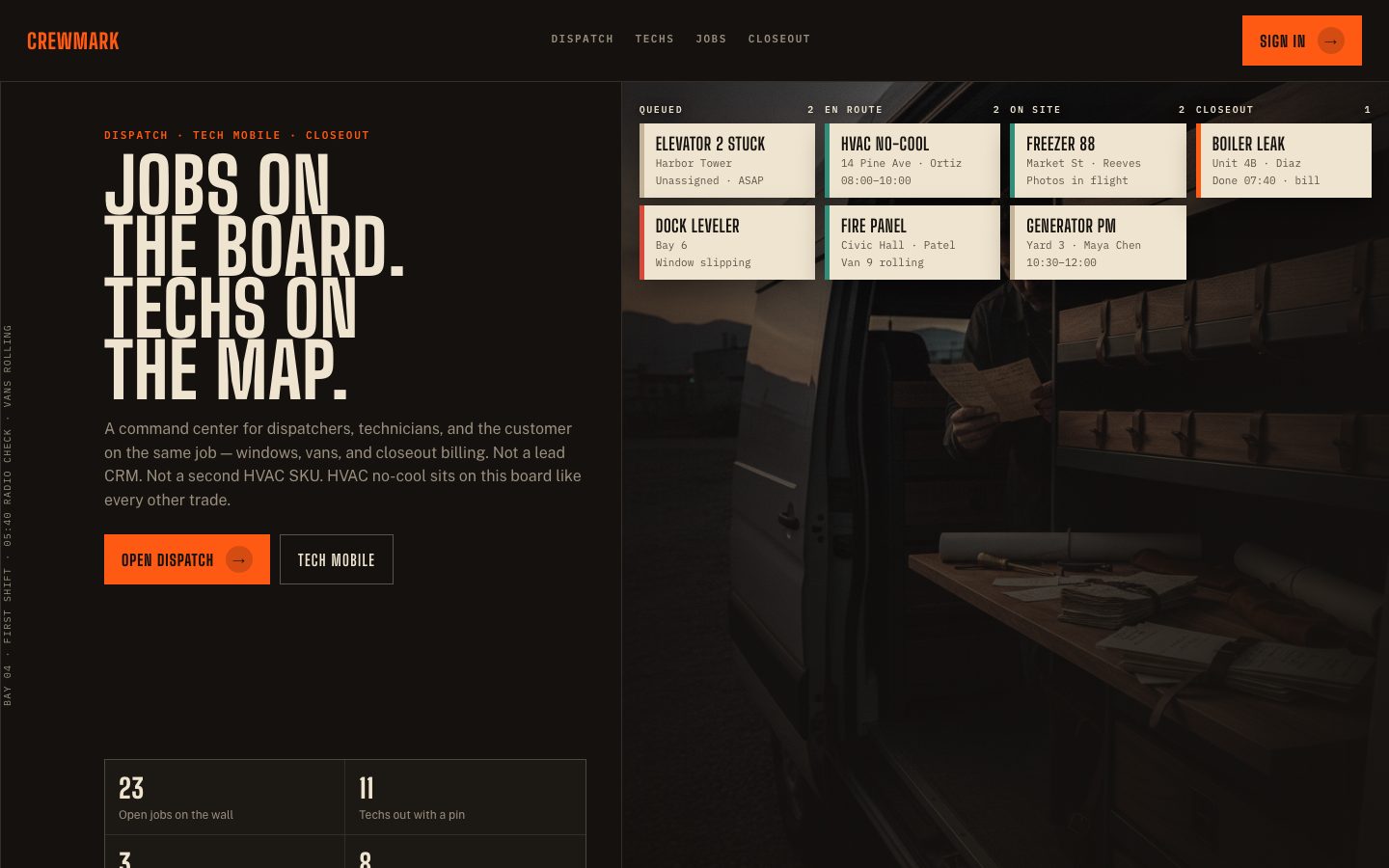
Field dispatch
A dispatch board, a technician view that works on a phone, and billing that won’t send an invoice before the work is done.

Property operations
Work orders by unit, maintenance visits, and a close-out the software refuses until the visit really happened.
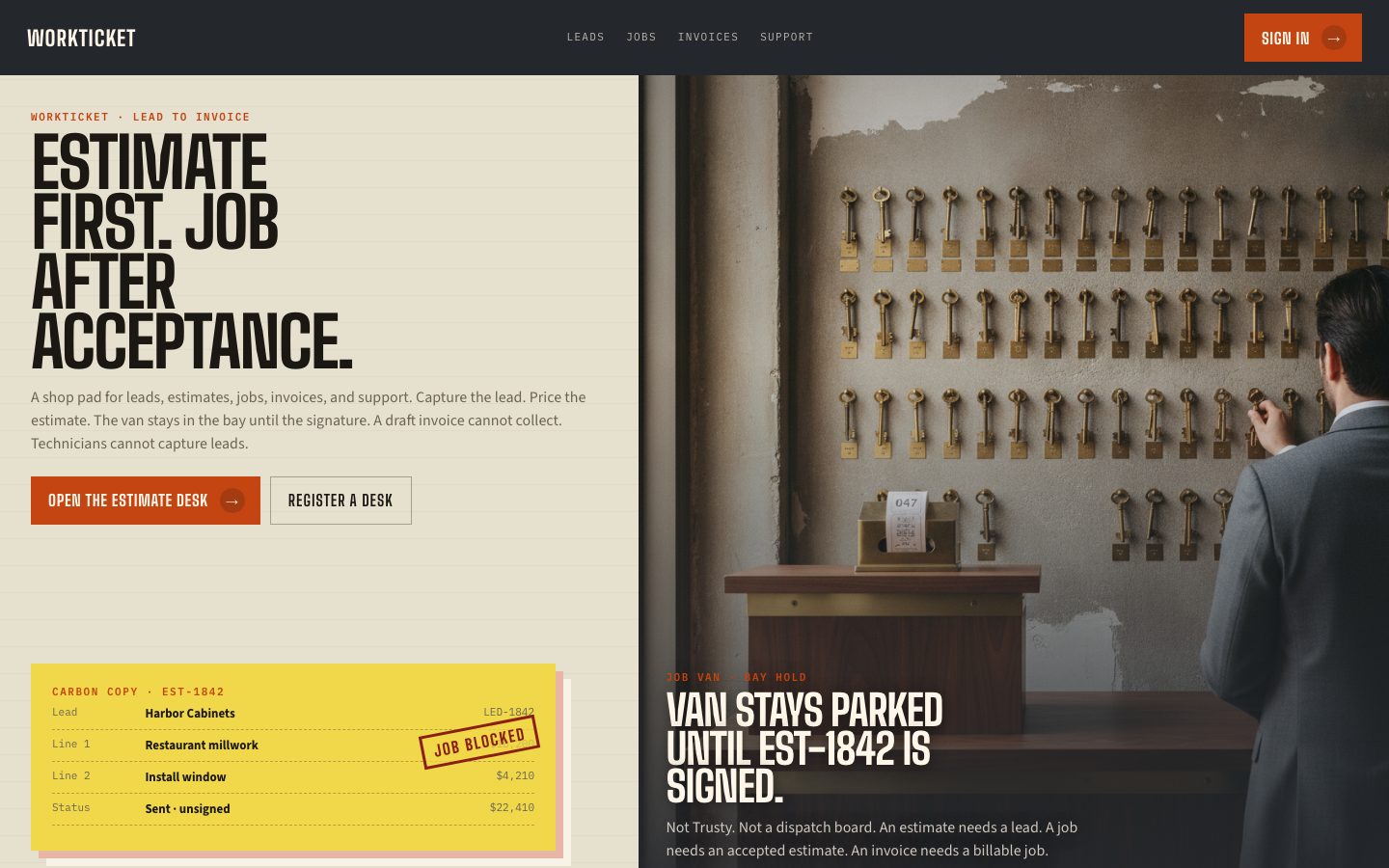
Service desk
Requests come in, work gets assigned, work gets closed.

Storage auctions
Auction tracking, a maximum bid the software won’t let you go over, costs per lot and profit per unit.
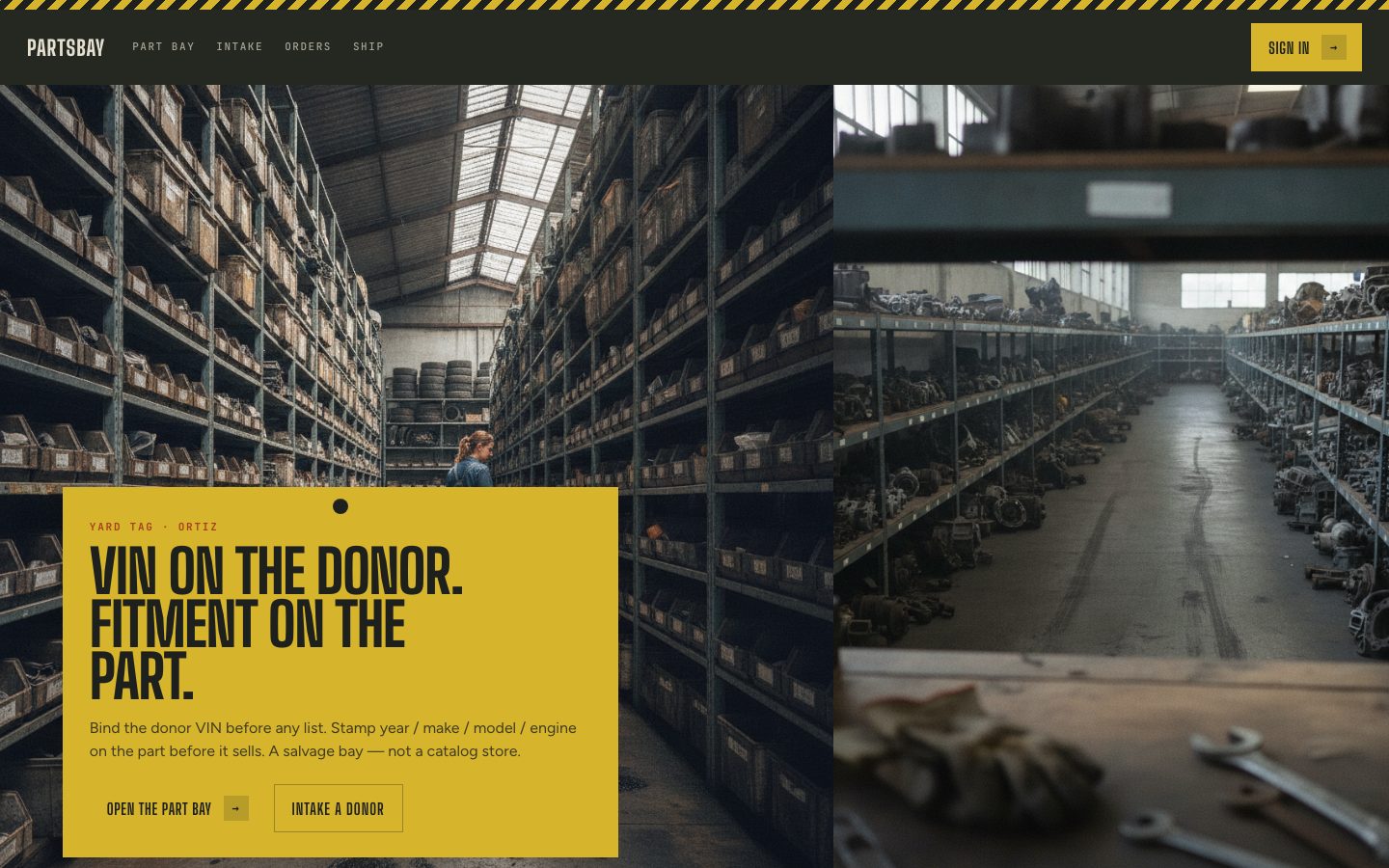
Auto-parts yard
VIN lookup, part identification, listings and orders: the yard’s stock and its storefront in one place.
Crew roster
Who is working, on what, and whether the work got done.
Rental yard
What’s out, what’s due back, and what it earned while it was gone.

Resale
Buy, document, list, sell and see the profit, with every change recorded.

Online courses
Dated cohorts, lessons, submissions and instructor review.

Studio planning
Briefs, illustration work and reviews: production planning for a creative studio.
How it works
What you describe becomes a written set of rules. The app is built from those rules, checked against them before launch, and kept tied to them once it is live.
Your answers become an executable business contract: records, roles, permissions, workflows, and what must never happen. The source of truth is what the business means—not whichever component was generated first.
ShipGate
ShipGate is separate from the part that builds your app. It tries to prove the app wrong, keeps a record of what it found, and gives one answer before launch: ship it, or don’t.

Verdictd3b9…4181
Volition
An AI agent can be talked into things. Your written rules can’t. Before an agent acts, Volition checks the action against your rules, signs the answer, and keeps a record.
Limits live in your rules, not in the agent’s instructions. An agent can’t give itself more power by rewriting what it was told, because nothing it says counts as a rule.
The same action against the same rules gets the same decision every time. No AI makes the call.
When a person approves something, it covers exactly that. Change the amount, the recipient or the target and it needs a new approval.
Anything that moves money is tied to the app that owns it, so nobody can bring their own rules to raise a limit they were never given.
When your rules say a person must decide, the agent waits for one. It doesn’t guess, and it doesn’t quietly give up.
We set AI agents loose on Volition to break its rules. We only count attacks that would have worked without Volition.
Instructions are not limits
Instructions and filters shape what an AI says. They don’t control what it can do. Volition sits outside the AI: the agent asks, your rules decide.
Agent
Any model. Any prompt.
Possibly compromised.
refund({ amount: 1400 })
Volition
Rulerefund.amount ≤ 1000
Denied
volition › decide("refund", { amount: 1400 })
[+] requested: 1400
[+] maximum:   1000
[!] DENIED REFUND_LIMIT_EXCEEDED
Payments
Never reached.
No refund issued.
Nothing changes in your books.
One recorded run, 2026-09-13. We only count attacks that worked with Volition switched off.
AI can suggest anything. Volition decides what it’s actually allowed to do, before money moves, data leaves, passwords are used, or your live system changes.
Start with one rule
Connect a project, say who can do what, and see every action that was allowed, blocked or sent to a person, with the record to prove it.
Start with Volition Or try to break it in the Arena →What we believe
A better way to ask
in·tent en·gi·neer·ing (n.) — writing down what must be true about a business, so a machine can compile it, execute it, and prove it. Prompt engineering asks a model nicely. Intent engineering leaves a receipt.
For engineers
Build, prove, and govern are separate servers with separate entitlements. Connect one, two, or all three — holding one never implies another.

mcp.wholestack.ai
Turn a described business into a compiled, verified, deployed full-stack application — database, permissions, and UI included.
wholestack_start_projectwholestack_discovery_nextwholestack_discovery_answerwholestack_intent_proposewholestack_intent_validatewholestack_previewwholestack_buildwholestack_provewholestack_deploywholestack_operate_statusScopes wholestack:build wholestack:deploy
mcp.shipgate.wholestack.ai
Independent verification against a contract — including software WholeStack did not build. Returns SHIP or NO_SHIP with the evidence behind it.
shipgate_create_contractshipgate_register_subjectshipgate_inspect_requirementsshipgate_runshipgate_verify_behaviorshipgate_verify_journeyshipgate_verify_runtimeshipgate_failuresshipgate_certificateshipgate_evidenceScopes shipgate:verify shipgate:certificate
mcp.volition.wholestack.ai
A deterministic authority boundary for autonomous agents, regardless of which model or framework is calling.
volition_contract_writevolition_inspect_contractvolition_propose_actionvolition_evaluatevolition_enforcevolition_runtime_enforcevolition_explainvolition_view_decisionvolition_view_audit_logvolition_download_evidenceScopes volition:evaluate volition:enforce
{
  "mcpServers": {
    "wholestack": { "url": "https://mcp.wholestack.ai" },
    "shipgate":   { "url": "https://mcp.shipgate.wholestack.ai" },
    "volition":   { "url": "https://mcp.volition.wholestack.ai" }
  }
}Pricing
One subscription covers WholeStack, ShipGate and Volition. AI usage is shown in dollars of credit, never tokens. Nothing paid is unlimited: AI is bounded by credits and hosting by hosted-app count.
$25 of AI credits each month, 1 seat. Workstation, unlimited local deterministic builds, ShipGate, executable contracts, essential Volition enforcement, source export and one hosted production app.
$50 of AI credits each month, 3 seats and team collaboration. Everything in Starter.
$90 of AI credits each month, 10 seats, team collaboration and Advanced Volition administration. Everything in Pro.
For larger teams and custom needs: more seats, custom terms and direct support. Everything in Ultra.
One more hosted production app on an active plan. Buying it never starts a server on its own; you choose which app it hosts.
Paid AI usage draws down dollar credits at our cost plus a stated margin. At zero, paid AI stops until you top up. Top-ups do not expire while your account is open.
FAQ
How WholeStack builds your software, checks it, and keeps checking it.
You answer plain questions about your business: what you keep track of, who does what, and what must never happen. WholeStack turns your answers into written rules, builds the app from them, and checks the app against them. You never write code.
ShipGate is separate from the part that builds. Before launch it tries to prove the app wrong: is everything you asked for there, do the buttons really do something, are the permissions tight, and does it work when it is actually running. Then it gives one answer, ship or don’t, with the evidence.
Its code, yes. WholeStack reads a GitHub repository you own, works out the records and workflows in it, and builds a new app from them, the same way it builds from a description. It cannot yet check software it did not build.
Every plan includes the WholeStack workstation, unlimited local deterministic builds, ShipGate, executable contracts, essential Volition enforcement, source export and one hosted production app while the plan is active. Starter is $49 per month with $25 of AI credits and 1 seat. Pro is $99 per month with $50 of AI credits, 3 seats and team collaboration. Ultra is $229 per month with $90 of AI credits, 10 seats, team collaboration and Advanced Volition administration. Extra hosted production apps are $69 per month each. AI credit top-ups are $10, $25 or $50. Paid AI usage draws down dollar credits; hosting is limited by hosted-app count.
Get started
You get the app, the written rules it was built from, and independent proof that it follows them.
 Software Supply