
Dispatch software that enforces the way your crews actually work.
Off-the-shelf field service platforms make you run your business their way. WholeStack captures the exact way you dispatch — multi-tech crews, trade certifications, drive-time buffers, photo sign-off, and escalation trees — and compiles it into a production system whose invariants hold at the database boundary.

What the compiled desk runs
A dispatch application is not a calendar. It is a set of transactional records and mathematical constraints about who may commit whose time, and what must be proven true before a work order closes.
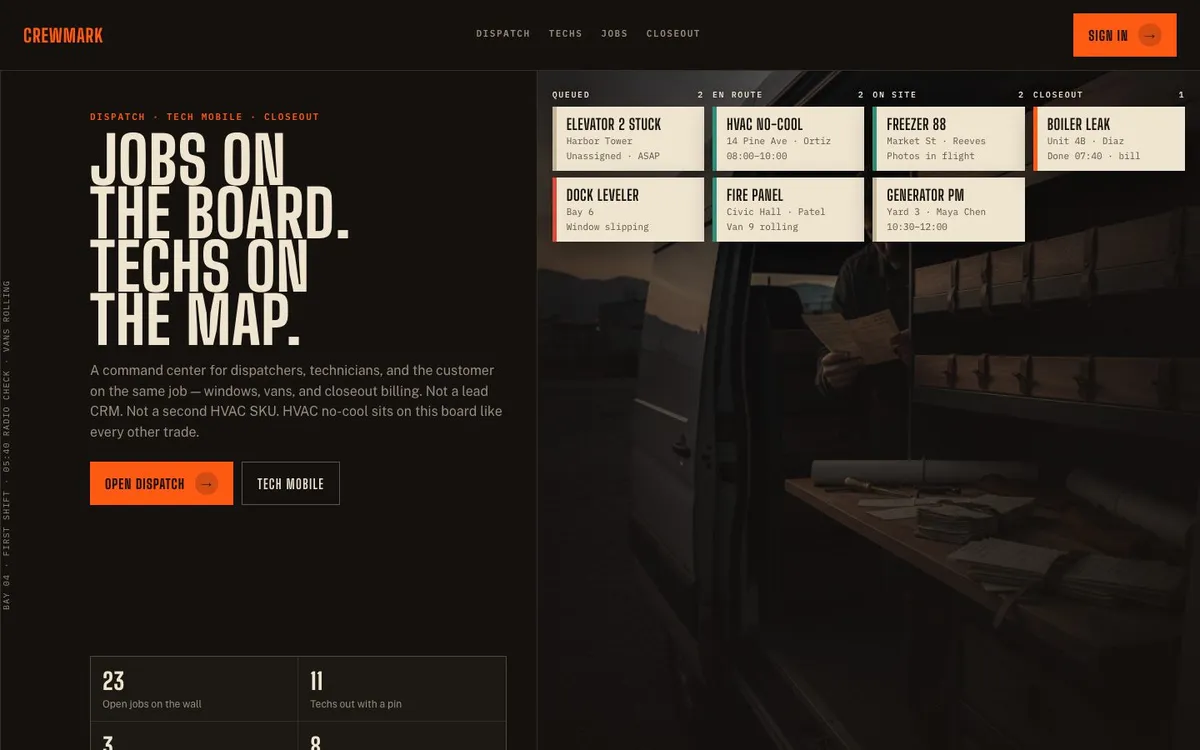
Schedule Board
Jobs, crews, and job sites mapped on a live board with travel-time buffers enforced as hard booked time.
Crew Certifications
Assignment verifies license validity. An expired EPA or high-voltage license instantly locks the technician out of the pool.
Proof of Work
Timestamped geo-verified photos and customer signatures attach directly to the job record before status can change to closed.
Schedule Board
Jobs, crews, and sites on one board, with travel time between stops treated as booked time rather than as slack.
Crew & Certification
Assignment checks the certification a job requires. An expired license removes the technician from the eligible pool.
Proof of Work
Photo and signature capture attached to the job record, not to a technician’s personal camera roll.
Inspections & Safety
Recurring checks generate their own work, and an overdue inspection escalates on a schedule you set.
Estimates to Invoices
The approved estimate is the exact entity that becomes the invoice, so line items cannot drift apart.
Customer Visibility
Commercial clients see their own jobs and nothing else, enforced by row ownership rather than by a filtered view.
The rules the contract enforces
These are written as business-contract invariants, compiled directly into PostgreSQL storage constraints and API permissions. Break one and the operation is refused at the engine boundary.
- R01 A job cannot close without sign-off The lead technician’s photo sign-off is a strict precondition of the completion transition. An unsigned job stays open no matter who presses the button.
- R02 Crews cannot be double-booked Two jobs whose windows overlap cannot hold the same crew. The second write is refused with the conflicting job ID and schedule conflict named.
- R03 Overdue safety checks escalate automatically A routine equipment check past its due date escalates to the operations director automatically, recorded as an immutable audit event.
- R04 Only dispatch reassigns active crews Technicians can update their job checklist and arrival state. Moving work between crews belongs to the dispatcher role alone.
What ShipGate checks before this launches
Dispatch is where a missed rule turns into a truck at the wrong address or an uncertified technician on a high-voltage roof. ShipGate sits outside the generation loop and tries to break the application before you rely on it.
Requirement Coverage
Every clause in your contract has an executing test. Uncovered clauses fail the gate immediately.
Non-Vacuity
Tests that pass because they assert nothing are treated as failures, not as coverage.
Security Boundaries
Technicians cannot see pricing or client billing. Each role is boundary-tested against records it must not touch.
Runtime Replay
The booted application replays real dispatch sequences against an isolated PostgreSQL instance before signing the release.
Frequently Asked Questions
How does it handle crews in areas with no cellular signal?
The mobile shell queues completions locally with client-side timestamps and syncs as soon as connectivity returns. Rules are verified against the timestamp recorded at capture.
Can we import our existing customer list and equipment registry?
Yes. Bring your schema and historical data via CSV or direct database dump. The compiler provisions matching entities and validates all existing records on import.
How long does a build take?
A working prototype compiles in seconds. The full verified build, including all contract invariants and simulated crew runs, finishes in under three minutes.
What if our safety regulations change next month?
You update the invariant in your intent contract. WholeStack re-proves the entire application against the new rule and ships an updated build with a fresh verification receipt.
Run dispatch on your terms.
One plan covers it: Starter is $49 per month with $25 of AI credits and 1 seat, Pro is $99 per month with $50 of AI credits, 3 seats and team collaboration, and Ultra is $229 per month with $90 of AI credits and 10 seats. Every plan includes ShipGate verification, source export and one hosted production app while the plan is active. Extra hosted apps are $69 per month each, and AI credit top-ups are $10, $25 or $50. Prices exclude tax.